

JULIAN OPIE LOCAL COLLECTORS JULIAN OPIE LOCAL COLLECTORS JULIAN OPIE LOCAL COLLECTORS JULIAN OPIE LOCAL COLLECTORS JULIAN OPIE LOCAL COLLECTORS JULIAN OPIE LOCAL COLLECTORS JULIAN OPIE LOCAL COLLECTORS JULIAN OPIE LOCAL COLLECTORS
- Masatoshi Kumagai
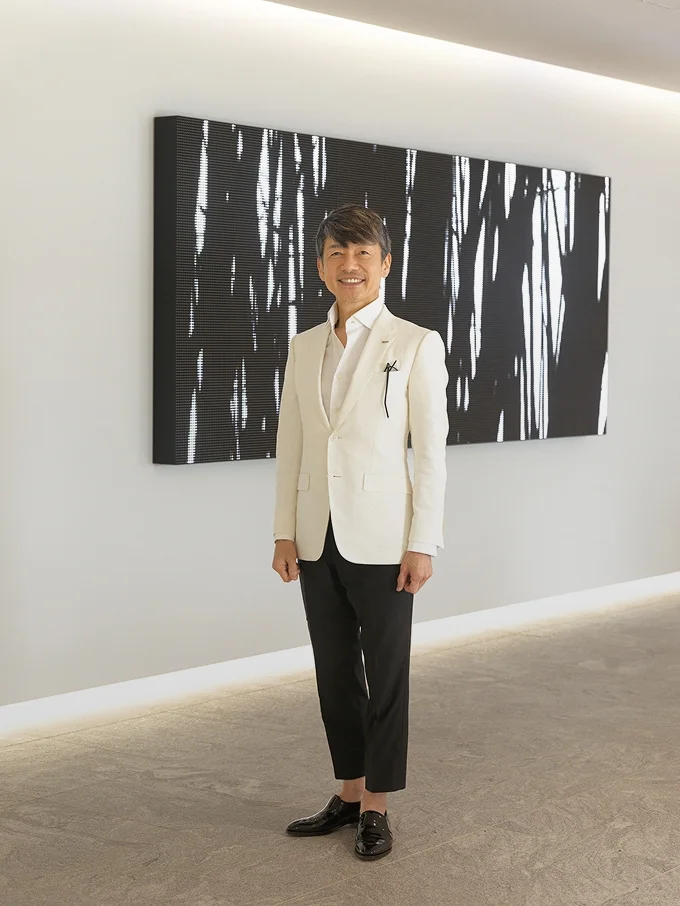
- Masatoshi Kumagai: Founded Voice Media (now GMO Internet Group) in 1991. The company provides a wide range of services for daily life and business, including domain registration, server hosting, online banking, securities and FX trading, and cryptocur- rency exchange operations.
- 01

We asked each of the collectors interviewed for this feature if they had a question for Opie. Kumagai, who is committed to consistently providing the best possible service, asked about what it means to be number one. He explained that as he built up his art collection, he thought about how he could become the “greatest” art collector. That’s when he decided to focus on the work of Julian Opie. Why Opie? “Our world is full of complex things. Yet humans remain the most enigmatic of all. Opie depicts people in a simplified way that makes me think of the internet – even the most complex screen images are composed of 0s and 1s. An entire world is constructed with these two elements. Likewise, Opie depicts complex worlds while portraying subjects with minimal detail. I felt instinctively drawn to that.”
Kumagai exhibited one of Opie’s LED works at the 2025 World Expo in Osaka, Japan. After close consultation with the artist, a new display unit was specially produced for the occasion. Kumagai believes that promoting culture helps keep a company from aging. “Sensibilities are key to providing our services. I respect engineers who write beautiful code, creators who build beautiful websites. Their sensibilities are no different from that of artists. That’s why it’s important for them to regularly engage with the real deal. I believe that creating office spaces filled with art will inspire us to provide beautiful services.”
- Question for Julian
- ― What “world firsts” would you like to realize through your art moving forward?
- From Julian: I’m not so interested in doing something first or even something new at all. I’m looking at what already exists, trying to grasp what is really there and find a way to make that process into an object to look at. Since the world is changing daily that seems enough. I play with things I know and find in the world, turn them this way and that, mix and combine in the ways I have learnt, until they sing. When I find a technology that can help in that process I grab it and use it whether it’s new or ancient. VR, Ai, LED or mosaic, stone carving, coloured beads.
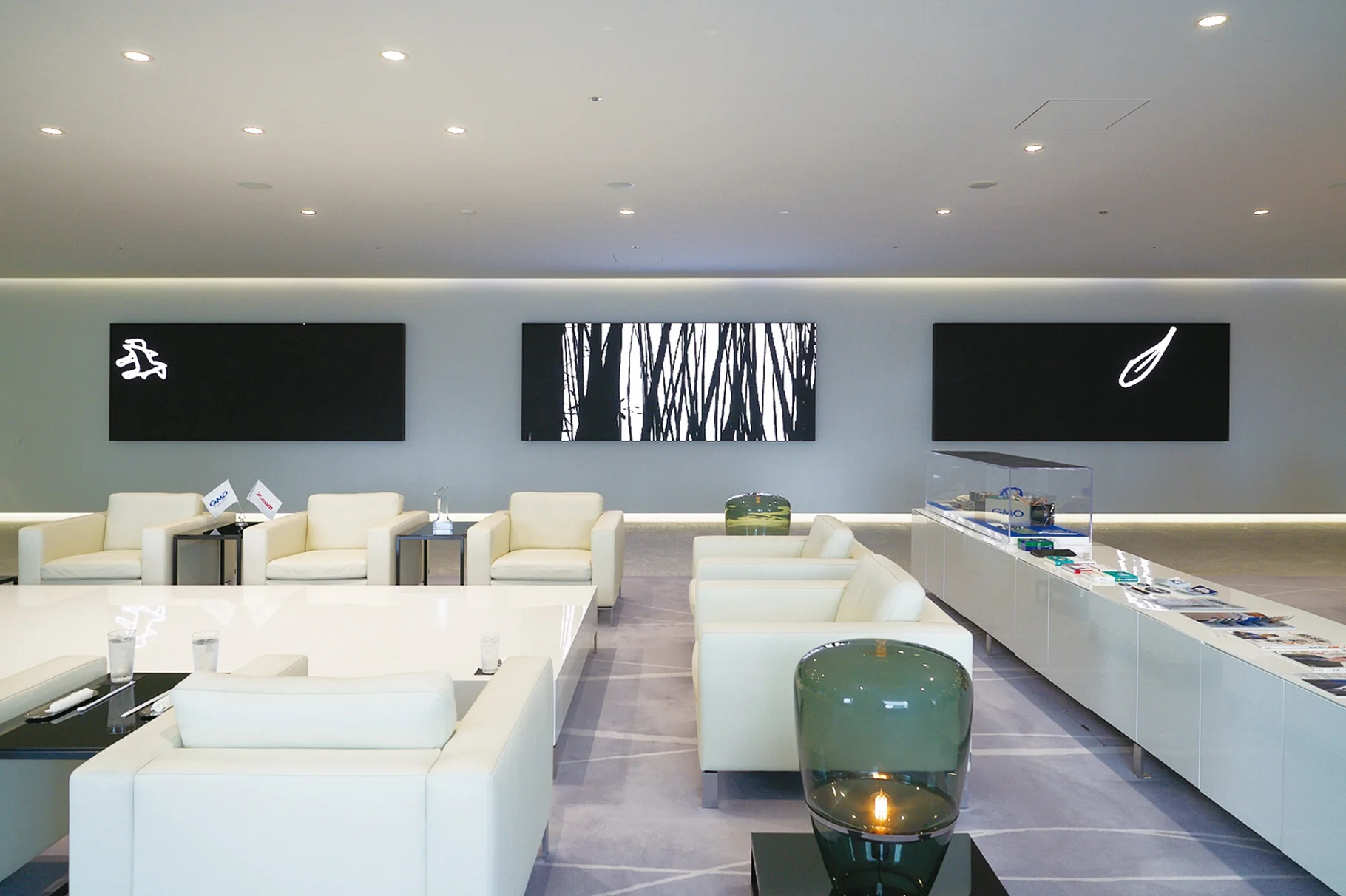
Kumagai owns over 100 works by Opie, most of which are displayed at his firm’s two headquarters. Mounted on the wall of the VIP reception room is the video installation “Gulls, Bamboo, Carp”. Seagulls, bamboo groves, and carp flow across 3.2 m screens.

Displayed in the VVIP conference room at the company’s second headquarters are, from left, “Jade” “Mark” “Stephanie” “Fabian” and “Julia”. The impressive, commissioned sculptures were crafted either in wood or marble to contrast with the wall material on which they are mounted.
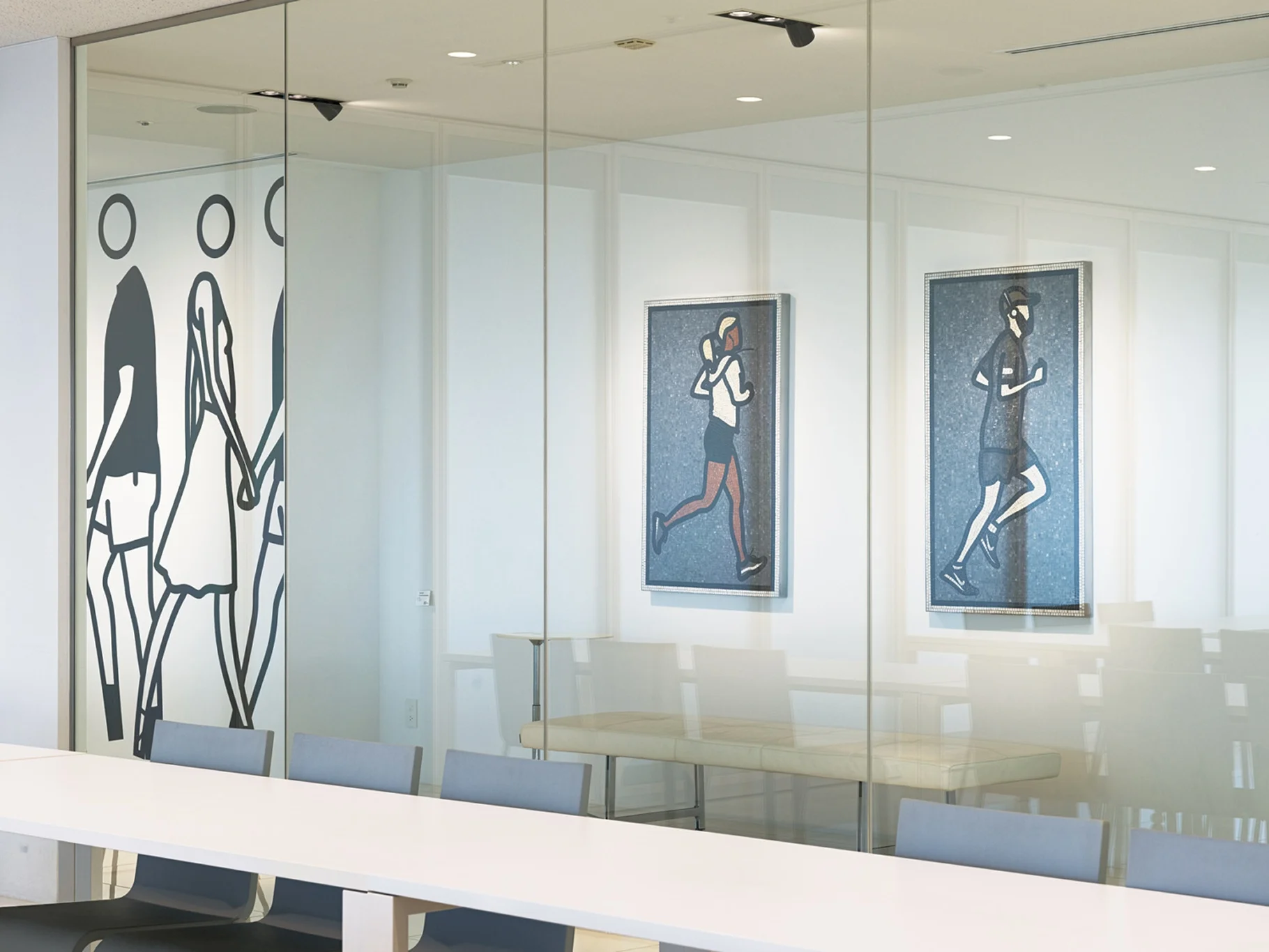
At the company’s main headquarters, glass walls in the meeting rooms give employees eye-catching views of the artwork on display. On the far wall are two contemporary figures rendered in mosaic tiles—from left to right, “Flight attendant. 1.” and “Taxi driver. 1.”

Artworks are displayed throughout the office, creating opportunities for employees to engage with art daily. Adorning the waiting area in the foreground is Opie’s humorously titled “ – OMP3045.jpg.ai.” In the meeting space beyond is his circular silkscreen “Ann, dancer. 1”.

Standing in front of the VIP reception desk at the firm’s main headquarters is the bronze figure “Telephone.” The piece, one of Kumagai’s favorites, depicts a woman clutching her smartphone, navigating urban life. The minimalist marble interior was designed by Hiroshi Nakamura.

On the conference room wall is “Watching Suzanne (front)”, a series of ten panels. At first glance the images appear identical, but like stop-motion animation, each depicts a dynamic pose. The counterpart series “Watching Suzanne (back)” is displayed in an adjacent room.
- Mariko Hayashi
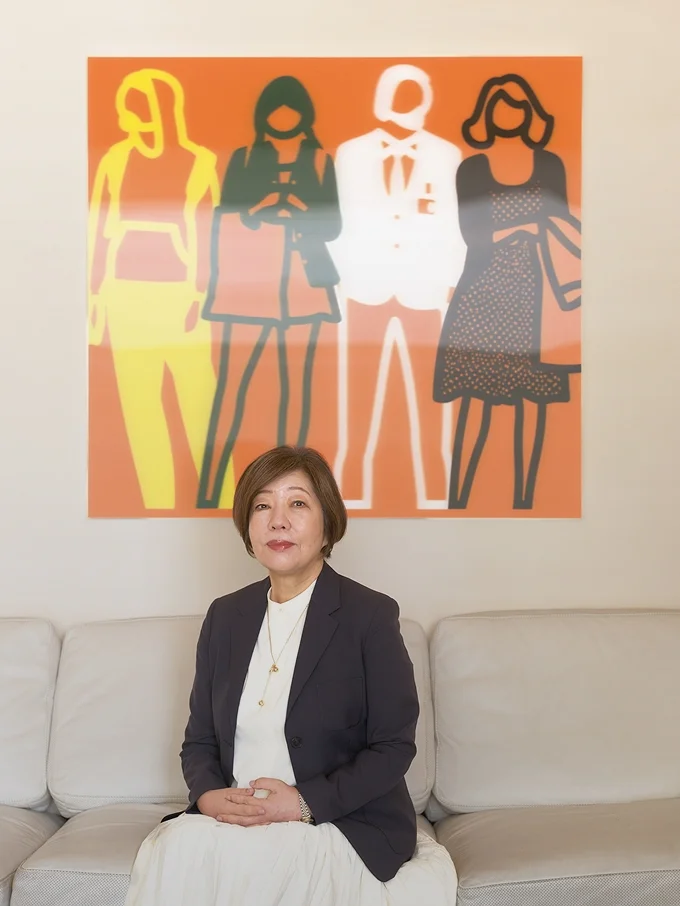
- Mariko Hayashi: Graduated from Nihon University. Published her first collection of essays, “Runrun Katte Ouchi ni Kaero,” in 1982. Won the Naoki literary prize in 1986 for “Saishubin ni Maniaeba” and “Kyoto made.” Received the Japanese Medal of Honor with Purple Ribbon in 2018.
- 02
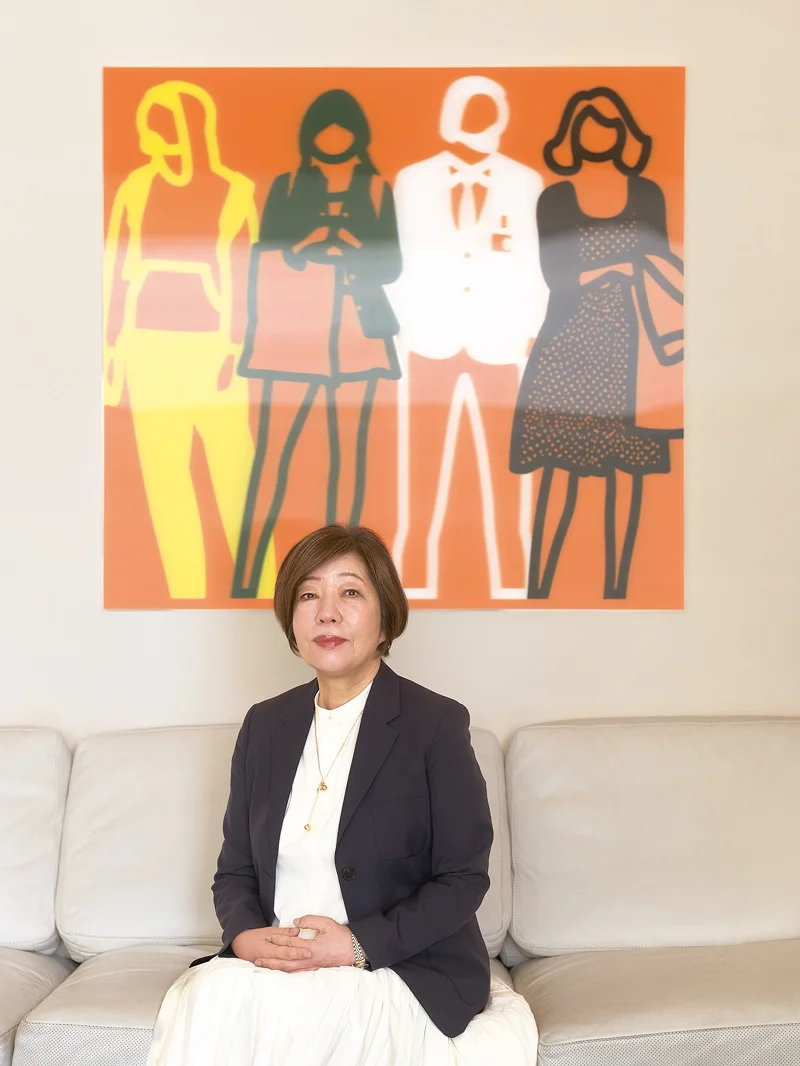
Although she modestly claims to know very little about art, she admits that she bought a piece by Yoshitomo Nara the year her daughter was born. “He’d just published his first art book. And the covers that he did for Banana Yoshimoto’s books were wonderful.”
Hayashi’s art collection stems from human connections. A drawing by Rikako Kawauchi she encountered when she served as a judge in an open call program for artists. Artworks purchased at Tokyo University of the Arts graduation exhibitions. Pieces featured as cover art for her books. Meanwhile, her private office at Nihon University, where she serves as chair, is adorned with paintings by Hiroshi Senju and Takayoshi Sakurai. “I sense serenity in Senju’s work, and radiant power in Sakurai’s. You could be the most successful person in the world – a house without a single painting feels lonely, sad. Art is essential for living a forward-looking life. And you can start small. I don’t approach it as an investment – I’m just decorating with an assortment of artwork that spoke to me.”
Sitting among her collection is a postcard she received from the gallery announcing Opie’s solo exhibition. “It was just so beautiful, I’ve kept it on display. I’m not the type who follows a single artist closely, but I’d love to encounter his work again.”
- Question for Julian
- ― Depicting the customs of the day can date a novel. Do you think about the clothes, etc. in your art becoming dated?
- From Julian: I’d hate to be dated. That would mean the artwork was based on received assumptions of the time that are now irrelevant. But I’m fine with the works being dateable as this suggests a connection to the world around me. It’s impossible to generalise when you have no overall plan or agenda. Which I don’t. I can only draw what I see and hope the truth in those observations will remain constant. A mobile phone, cigarette, or this year’s fashion will soon be out of date but the underlying process of looking and composing remains relevant. Any attempt at timelessness in figurative or abstract art is futile and maybe even becomes propaganda. I wouldn’t draw a vape or an e-scooter though. There are limits.
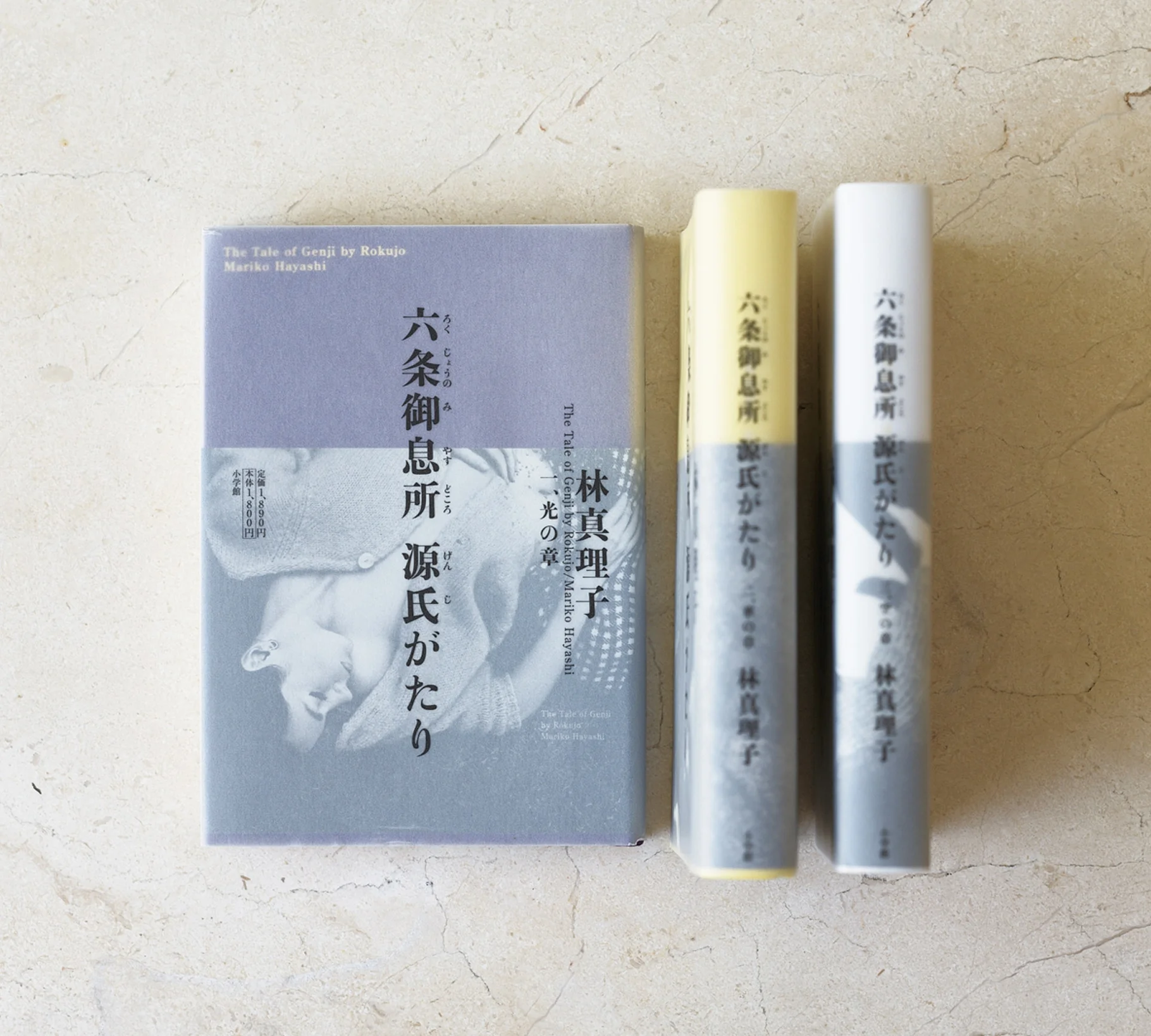
Hayashi says the cover art for her books are dear to her heart – in particular, the covers Yuji Kimura designed for “Lady Rokujō: The Tale of Genji,” a bold re-interpretation of the Japanese literary classic. Displayed in her office are pieces related to her own work, including art by painter Kuniyoshi Kaneko and the manuscript for a blurb written by Seicho Matsumoto.
- Yu Kimoto
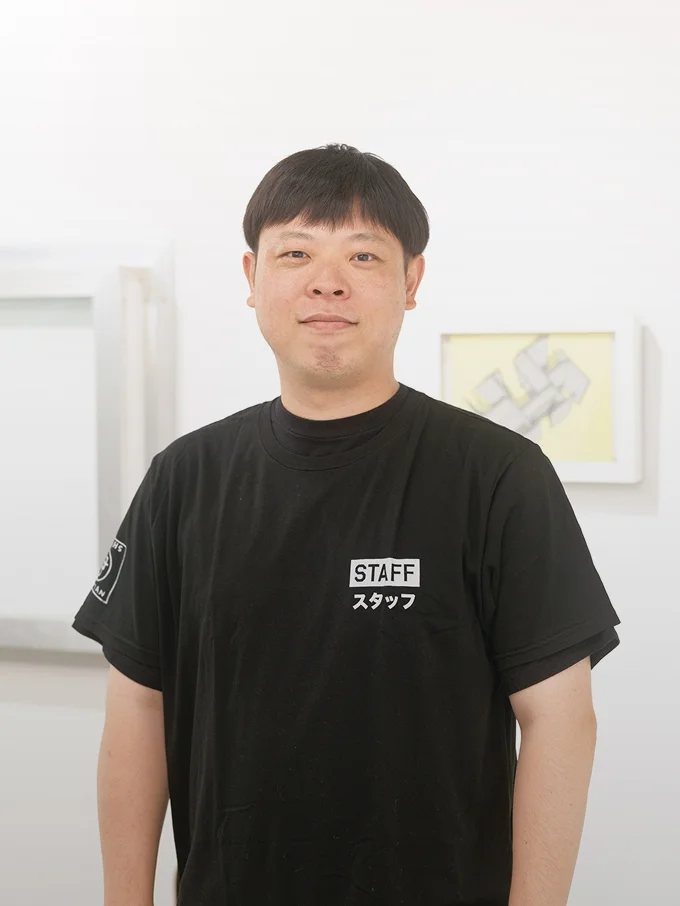
- Started at a creative agency and later founded PLAY in 2014 and FLAG in 2016 to provide consulting and digital creative services. Began collecting art around 2006. Launched “CLTV STUDIO,” a hub for collectors, in 2024; plans to launch an asset management platform in 2026.
- 03
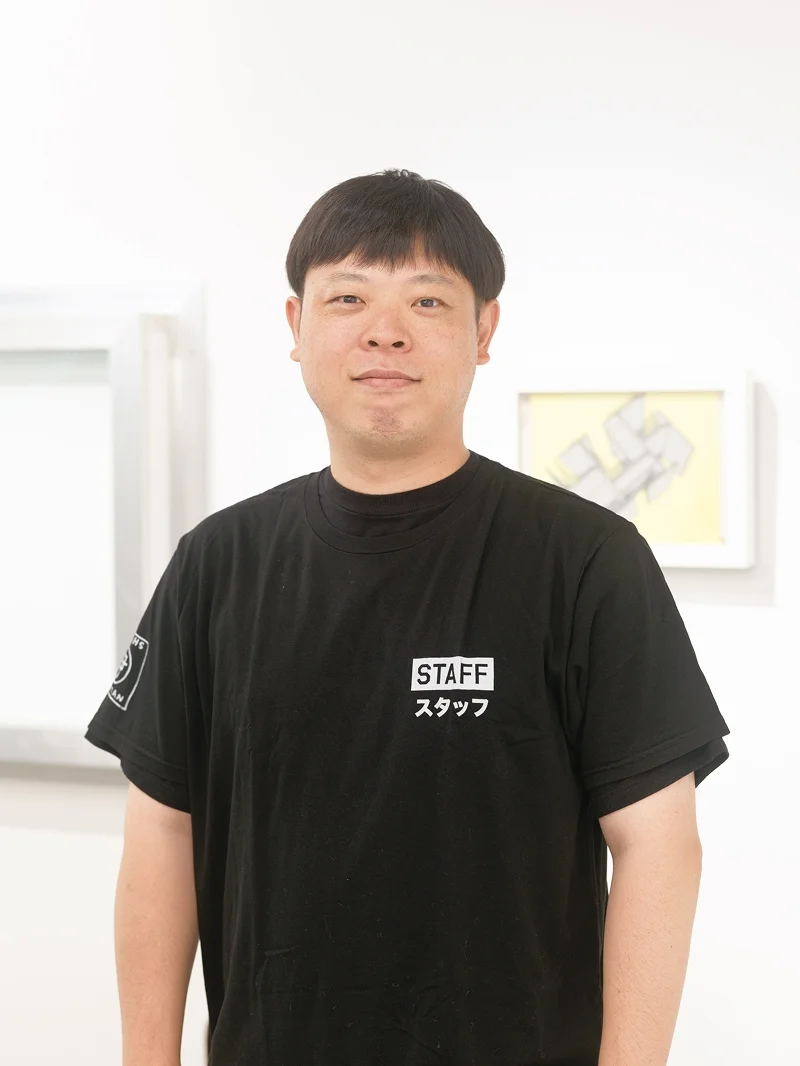
Among Kimoto’s collection is an early piece by Julian Opie that was unveiled at a solo show at Kohji Ogura Gallery in 1991. “Before that piece, I was focused on buying artists’ most iconic works. But acquiring it changed my perspective. It’s very different stylistically from Opie’s art today, but I sensed a common thread. In his work, figures are rendered as outlines and landscapes are framed. I began to think that framing might be fundamental to his art.”
Intrigued, Kimoto traced the evolution of Opie’s art from his early career up to the present. And he found he enjoyed looking back so much that it changed his approach to collecting. “As long as artists create, they continue to evolve. The fact that we can’t yet see the full scope of their art is what’s fascinating. Their work is influenced by changes in society and the times we live in. Getting to witness the moves an artist makes in real time is such a privilege.”
Kimoto says that while Opie’s methods have evolved, his singular vision has remained unchanged. He finds the artist’s works to be highly spatial even when they are expressed on a two-dimensional surface. “He’s always conscious of depth. His minimalist depiction of the world stands out in a space such as a gallery or museum, but when the work is installed in a real urban environment, it takes on a whole new appeal. Some viewers may see narrative elements, while others might perceive a pop sensibility or cuteness. It’s exceptionally rare to find an artist whose work maintains its distinct character and capacity for interpretation in any space. Above all, his art has the power to captivate.”
- Question for Julian
- ― If you took a time machine 20 years into the future to see what you are up to, what would you be making?
- From Julian: Whatever I set out to do I seem to circle back to a similar kind of result. I’m often desperate to make something different but whichever direction I go in I realise I have been there before. What changes is my point of view, my resources and the world around me. It’s as if I’m performing the same trick again and again but with different material. Sometimes I imagine what my student self would make of the things I am producing now which is the same question in reverse. I hope he would approve and I think he would recognise the work and underlying activity. I work hard most days because it’s great fun. I really hope I will feel the same in twenty years time.

Julian Opie’s “6.75 x 169 x 10.5 cm” (1989). The architectural work, composed of frame and glass, is complimented by a chair designed by Kenzo Tange. Kimoto’s collection, which includes works by artists such as Lawrence Weiner and Tatsuo Miyajima, is housed at his office/showroom CLTV STUDIO.
- AKI INOMATA
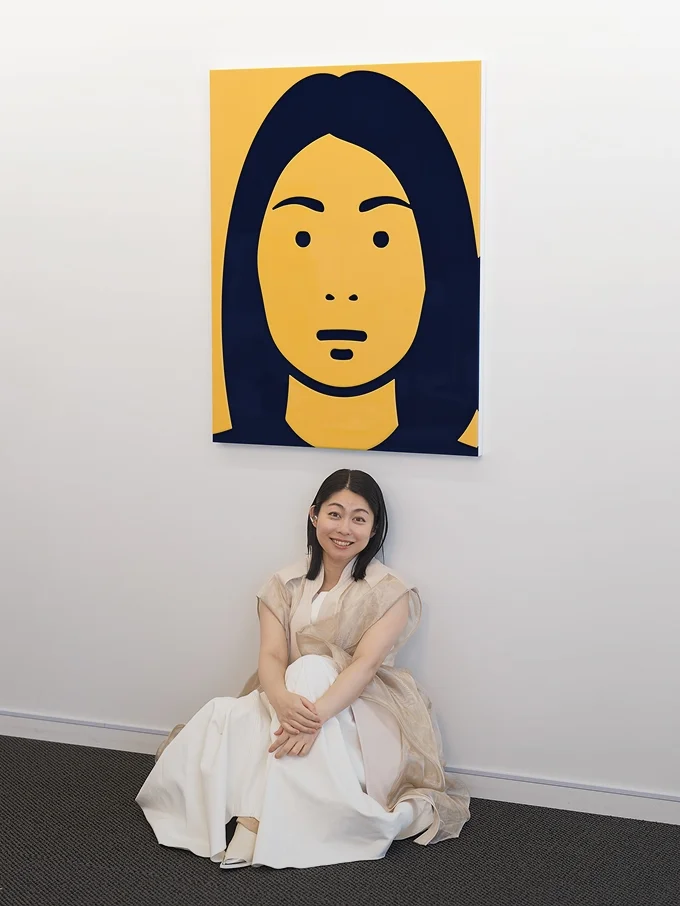
- Artist. Visiting Professor, Musashino Art University. Develops collaborations with living creatures into works of art. Her work is held by museums such as MoMA and the 21st Century Museum of Contemporary Art, Kanazawa. Here, she sits under Opie’s piece “Aki.”
- 04
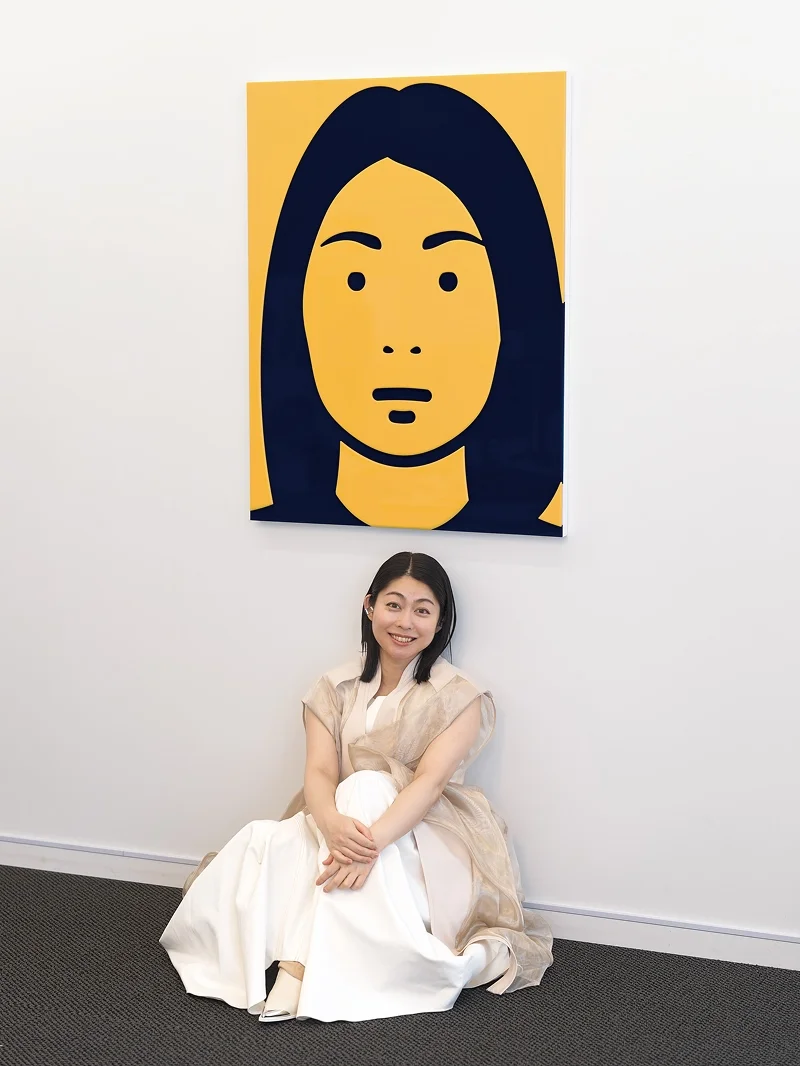
“I’m drawn to artwork with a positive outlook. Julian’s pieces are multifaceted, and words alone don’t do them justice, but they are profoundly positive, urban, and imbued with a contemporary feel. He was an early adopter of digital tools, and his approach to creating with new technology feels natural and unforced because he’s committed to depicting the everyday lives of ordinary people.”
Inomata herself utilizes digital tools: as part of her project “Thinking of Yesterday’s Sky” (2020) she 3D printed cloud patterns. She sees modern technology as a means of expression – the key is the message. She expresses deep respect for the way Opie balances the two. “He’s very down to earth. In a conversation we had about life and family, what stuck with me was hearing about his travels around the world. He knew that I use hermit crabs as a motif, so he showed me beautiful photos of the creatures he’d taken on a trip. I’d assumed he was a city person, but he loves nature. His ability to flatten scenery is unmatched, and he instills his work with the resonance of ordinary moments. Similarly, his portraits are minimal, yet they capture an individual’s personality. It’s a testament to his keen powers of observation.”
- Question for Julian
- ― You are constantly updating your works, even within the same series. How are you able to do that?
- From Julian: I seem to work in series. I have an initial premise. It’s usually just some small observation or question sparked by the real world or maybe by other art, new or ancient. This begins a months long process that can produce tens or hundreds of works. It’s like getting on a surf board and riding a wave. While the wave rolls I try to produce all that is in my reach and then all of a sudden I realise it’s over. I never go back as it’s over and best left alone but the waves are all similar and I realise I’m just coming at the same things with new material and new images and technologies.

A new piece from Inomata’s series “Thinking of Yesterday’s Sky,” which she started in 2022. Using a proprietary 3D printing technique, she recreates cloud patterns within a glass filled with liquid. Developed during the pandemic, the series emerged from her realization that today will never be the same as yesterday.